Territorial Availability: Available through Bertin Technologies only in France
- Correlated keywords
- sn RNP SMN 1 2 ?7 gemin2 gemin1 Component of Gems 1 OTTHUMP00000125198 OTTHUMP00000223567 OTTHUMP00000223568 OTTHUMP00000224066 OTTHUMP00000226924 SMA 3 4 SMA1 SMA2 SMA3 SMA4 SMNT T-BCD541
- Product Overview:
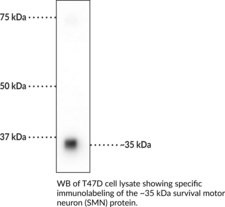
The survival motor neuron (SMN) protein is a ubiquitously expressed, multifunctional protein with roles in a variety of cellular processes, including small nuclear ribonucleoprotein (snRNP) and spliceosome assembly, translation, cytoskeletal dynamics, and stress granule formation.{56204,56205} It is a 294-amino acid protein encoded by SMN1 in humans and is comprised of an N-terminal basic/lysine-rich domain that interacts with RNA and Gemin-2, a central Tudor domain (Item No. 14136) that functions in a variety of protein-protein interactions, a proline-rich region, and a C-terminal YG box that facilitates SMN oligomerization. Humans also have a second centromeric copy of the gene, called SMN2, that is the result of duplication and inversion and primarily produces a truncated isoform, SMN?7, which is less stable, but can also produce small amounts of SMN. Knockout of Smn is embryonic lethal in mice.{56204} In humans, mutations in SMN1 are associated with spinal muscular atrophy (SMA), a neuromuscular disorder characterized by degeneration of ? motor neurons in the spinal cord and muscle weakness. Cayman’s SMN Monoclonal Antibody can be used for immunocytochemistry (ICC) and Western blot (WB) applications. The antibody recognizes SMN protein at approximately 35 kDa from human, mouse, and rat samples.
Cayman Chemical’s mission is to help make research possible by supplying scientists worldwide with the basic research tools necessary for advancing human and animal health. Our utmost commitment to healthcare researchers is to offer the highest quality products with an affordable pricing policy.
Our scientists are experts in the synthesis, purification, and characterization of biochemicals ranging from small drug-like heterocycles to complex biolipids, fatty acids, and many others. We are also highly skilled in all aspects of assay and antibody development, protein expression, crystallization, and structure determination.
Over the past thirty years, Cayman developed a deep knowledge base in lipid biochemistry, including research involving the arachidonic acid cascade, inositol phosphates, and cannabinoids. This knowledge enabled the production of reagents of exceptional quality for cancer, oxidative injury, epigenetics, neuroscience, inflammation, metabolism, and many additional lines of research.
Our organic and analytical chemists specialize in the rapid development of manufacturing processes and analytical methods to carry out clinical and commercial GMP-API production. Pre-clinical drug discovery efforts are currently underway in the areas of bone restoration and repair, muscular dystrophy, oncology, and inflammation. A separate group of Ph.D.-level scientists are dedicated to offering Hit-to-Lead Discovery and Profiling Services for epigenetic targets. Our knowledgeable chemists can be contracted to perform complete sample analysis for analytes measured by the majority of our assays. We also offer a wide range of analytical services using LC-MS/MS, HPLC, GC, and many other techniques.
Accreditations
ISO/IEC 17025:2005
ISO Guide 34:2009
Cayman is a leader in the field of emerging drugs of abuse, providing high-purity Schedule I-V Controlled Substances to federally-licensed laboratories and qualified academic research institutions for forensic analyses. We are certified by ACLASS Accreditation Services with dual accreditation to ISO/IEC 17025:2005 and ISO Guide 34:2009.