Territorial Availability: Available through Bertin Technologies only in France
- Correlated keywords
- histones chromatin PHD domains zinc fingers epigenetics methylation plants homeodomains binding binds tudors multidomain-containing multidomains containing multi-domains nuclear proteins DNA methylation H3 Hthree three H promyelocytic leukemia PML methyl readers genes regulations cancers nuclear Np95 Np 95 HuNp95 hNp95 ubiquitin-like-containing ubiquitin like containing RING one 1
- Product Overview:
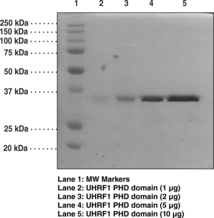
Recognition of epigenetic marks can be mediated by small modular protein units of ~50 amino acids called Plant Homeodomain (PHD) fingers. PHD fingers are zinc binding domains that have a Cys4-His-Cys3 motif and are found in more than 100 nuclear proteins that play a role in regulating chromatin.{23085} PHD domains often work with other protein regions, such as bromodomains and Tudor domains, to recognize post-translational modifications in many proteins.{23085} Ubiquitin-like with PHD and ring finger domains 1 (UHRF1) is a multidomain-containing nuclear protein known to bind chromatin and participate in the maintenance of DNA methylation.{23843,23841} The SET and RING associated domain of UHRF1, also called the YDG motif, binds methyl cytosines, while trimethylated histone H3 lysine 9 (H3K9me3) and unmethylated histone H3 Arginine 2 (H3R2me0) are recognized by the tandem Tudor-like domains and the PHD domain, respectively.{23842,23851,23847,23844,23846,23849} Some evidence suggests the tandem Tudor-like region and adjacent PHD domain may operate together to recognize H3K9me3.{23850} The combinatorial recognition of the histone tail region and hemi-methylated DNA functions to regulate gene silencing by directly interacting with DNA (cytosine-5)-methyltransferase 1.{23853,23843,23852} UHRF1 also posseses E3 ubiquitin ligase activity toward histone H3 and the tumor suppressor promyelocytic leukemia protein.{23844,23845} This protein product contains the PHD finger region of UHRF1.
Cayman Chemical’s mission is to help make research possible by supplying scientists worldwide with the basic research tools necessary for advancing human and animal health. Our utmost commitment to healthcare researchers is to offer the highest quality products with an affordable pricing policy.
Our scientists are experts in the synthesis, purification, and characterization of biochemicals ranging from small drug-like heterocycles to complex biolipids, fatty acids, and many others. We are also highly skilled in all aspects of assay and antibody development, protein expression, crystallization, and structure determination.
Over the past thirty years, Cayman developed a deep knowledge base in lipid biochemistry, including research involving the arachidonic acid cascade, inositol phosphates, and cannabinoids. This knowledge enabled the production of reagents of exceptional quality for cancer, oxidative injury, epigenetics, neuroscience, inflammation, metabolism, and many additional lines of research.
Our organic and analytical chemists specialize in the rapid development of manufacturing processes and analytical methods to carry out clinical and commercial GMP-API production. Pre-clinical drug discovery efforts are currently underway in the areas of bone restoration and repair, muscular dystrophy, oncology, and inflammation. A separate group of Ph.D.-level scientists are dedicated to offering Hit-to-Lead Discovery and Profiling Services for epigenetic targets. Our knowledgeable chemists can be contracted to perform complete sample analysis for analytes measured by the majority of our assays. We also offer a wide range of analytical services using LC-MS/MS, HPLC, GC, and many other techniques.
Accreditations
ISO/IEC 17025:2005
ISO Guide 34:2009
Cayman is a leader in the field of emerging drugs of abuse, providing high-purity Schedule I-V Controlled Substances to federally-licensed laboratories and qualified academic research institutions for forensic analyses. We are certified by ACLASS Accreditation Services with dual accreditation to ISO/IEC 17025:2005 and ISO Guide 34:2009.