Territorial Availability: Available through Bertin Technologies only in France
- Correlated keywords
- BDA BMP 2 4 7 A TGF? Escherichia
- Product Overview:
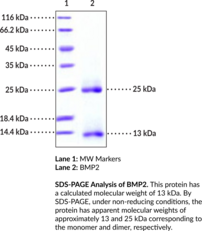
Bone morphogenetic protein 2 (BMP2) is a member of the TGF-? superfamily of growth factors that has roles in osteogenesis and embryogenesis.{54170} It is composed of an N-terminal prodomain that regulates BMP2 folding and secretion and a C-terminal mature domain that contains the receptor binding region. BMP2 is expressed by chondrocytes, osteocytes, osteoblasts, and vascular endothelial cells and is synthesized in the cytosol as a proprotein dimer.{54171,54172} Cleavage of the proprotein dimer by proprotein convertase subtilisin kexins (PCSKs) generates the N- and C-terminal domains, which remain non-covalently associated and homodimerize or heterodimerize with BMP4 or BMP7 prior to secretion.{54171} BMP2 preferentially binds to BMP type 1 receptors, also known as activin receptor-like kinases (ALKs), which are expressed by mesenchymal or hematopoietic stem cells, chondrocytes, osteoblasts, osteoclasts, and myoblasts, and activates SMAD-dependent and -independent gene transcription.{54170,54173} BMP2 induces production of collagen type I ? and alkaline phosphatase, a marker of bone formation, as well as induces differentiation and proliferation of bone marrow-derived mesenchymal stem cells in vitro.{54174} Genome-wide deletion of Bmp2 in mice induces amnion, chorion, and cardiac developmental defects and is embryonic lethal.{54170} Limb-specific Bmp2 conditional knockout mice exhibit spontaneous fractures and impaired fracture healing.{54175} Serum and synovial fluid BMP2 levels are increased in patients with osteoarthritis and are positively correlated with disease severity.{54176} Formulations containing BMP2 have been used in treatment of long bone fractures. Cayman’s BMP2 (recombinant) protein can be used for cell-based assay applications. This protein consists of 115 amino acids that correspond to the mature form of human, canine, mouse, rat, and rhesus BMP2 and has a calculated molecular weight of 13 kDa. By SDS-PAGE, under non-reducing conditions, the protein has apparent molecular weights of approximately 13 and 25 kDa, corresponding to the monomer and dimer, respectively.
Cayman Chemical’s mission is to help make research possible by supplying scientists worldwide with the basic research tools necessary for advancing human and animal health. Our utmost commitment to healthcare researchers is to offer the highest quality products with an affordable pricing policy.
Our scientists are experts in the synthesis, purification, and characterization of biochemicals ranging from small drug-like heterocycles to complex biolipids, fatty acids, and many others. We are also highly skilled in all aspects of assay and antibody development, protein expression, crystallization, and structure determination.
Over the past thirty years, Cayman developed a deep knowledge base in lipid biochemistry, including research involving the arachidonic acid cascade, inositol phosphates, and cannabinoids. This knowledge enabled the production of reagents of exceptional quality for cancer, oxidative injury, epigenetics, neuroscience, inflammation, metabolism, and many additional lines of research.
Our organic and analytical chemists specialize in the rapid development of manufacturing processes and analytical methods to carry out clinical and commercial GMP-API production. Pre-clinical drug discovery efforts are currently underway in the areas of bone restoration and repair, muscular dystrophy, oncology, and inflammation. A separate group of Ph.D.-level scientists are dedicated to offering Hit-to-Lead Discovery and Profiling Services for epigenetic targets. Our knowledgeable chemists can be contracted to perform complete sample analysis for analytes measured by the majority of our assays. We also offer a wide range of analytical services using LC-MS/MS, HPLC, GC, and many other techniques.
Accreditations
ISO/IEC 17025:2005
ISO Guide 34:2009
Cayman is a leader in the field of emerging drugs of abuse, providing high-purity Schedule I-V Controlled Substances to federally-licensed laboratories and qualified academic research institutions for forensic analyses. We are certified by ACLASS Accreditation Services with dual accreditation to ISO/IEC 17025:2005 and ISO Guide 34:2009.