Territorial Availability: Available through Bertin Technologies only in France
- Correlated keywords
- F antiangiogenic extra cellular PNPLA 2 Gln 20 cDNA1 EPC1 glyco protein SERPINF 1 noninhibitory
- Product Overview:
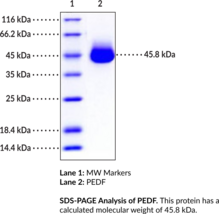
Pigment epithelium-derived factor (PEDF) is a secreted glycoprotein encoded by the SERPINF1 gene.{54180} It is a non-inhibitory member of the serine-protease inhibitor (SERPIN) superfamily that has anti-angiogenic and neurotrophic activities. PEDF is a 418-amino acid protein comprised of an N-terminal region important for its neurotrophic activity, three ?-sheets and ten ?-helices that make up an ?/? core serpin domain, and a C-terminal region containing a glycosylation site.{54180,54181} It has an asymmetrical charge distribution with the basic region involved in glycosaminoglycan binding and the acidic region binding to collagen I.{54181} PEDF is ubiquitously expressed and localized to the extracellular matrix but can also be found in the cytoplasm and nucleus of retinal pigment epithelial cells and certain cancer cell lines.{54180,54182} It contains biologically active peptides, including a 34-amino acid peptide (amino acids 44-77), which contains a laminin receptor binding site and has anti-angiogenic, bone mineralization, and apoptotic activities, and a 44-amino acid peptide (amino acids 78-121), which contains a PNPLA2 binding site and promotes neuronal differentiation and inhibits vascular permeability.{54180,54183,54184} PEDF also interacts with collagen I for its anti-angiogenic activity, as well as with sulfated (heparin) and non-sulfated (hyaluronan) glycosaminoglycans, which are important for PNPLA2 receptor binding and activation of caspases, respectively.{54180,54181} Its expression is reduced in a variety of cancer cell lines and solid tumors, and the reduction is associated with metastasis and poor prognosis.{54181} Mutations in SERPINF1 are responsible for the hereditary bone dysplasia disorder osteogenesis imperfecta type VI, which is characterized by bone fragility, deformity, and growth deficiency.{54185} Cayman’s PEDF (human, recombinant) protein consists of 410 amino acids, has a calculated molecular weight of 45.8 kDa, and a predicted N-terminus of Gln20 after signal peptide cleavage.
Cayman Chemical’s mission is to help make research possible by supplying scientists worldwide with the basic research tools necessary for advancing human and animal health. Our utmost commitment to healthcare researchers is to offer the highest quality products with an affordable pricing policy.
Our scientists are experts in the synthesis, purification, and characterization of biochemicals ranging from small drug-like heterocycles to complex biolipids, fatty acids, and many others. We are also highly skilled in all aspects of assay and antibody development, protein expression, crystallization, and structure determination.
Over the past thirty years, Cayman developed a deep knowledge base in lipid biochemistry, including research involving the arachidonic acid cascade, inositol phosphates, and cannabinoids. This knowledge enabled the production of reagents of exceptional quality for cancer, oxidative injury, epigenetics, neuroscience, inflammation, metabolism, and many additional lines of research.
Our organic and analytical chemists specialize in the rapid development of manufacturing processes and analytical methods to carry out clinical and commercial GMP-API production. Pre-clinical drug discovery efforts are currently underway in the areas of bone restoration and repair, muscular dystrophy, oncology, and inflammation. A separate group of Ph.D.-level scientists are dedicated to offering Hit-to-Lead Discovery and Profiling Services for epigenetic targets. Our knowledgeable chemists can be contracted to perform complete sample analysis for analytes measured by the majority of our assays. We also offer a wide range of analytical services using LC-MS/MS, HPLC, GC, and many other techniques.
Accreditations
ISO/IEC 17025:2005
ISO Guide 34:2009
Cayman is a leader in the field of emerging drugs of abuse, providing high-purity Schedule I-V Controlled Substances to federally-licensed laboratories and qualified academic research institutions for forensic analyses. We are certified by ACLASS Accreditation Services with dual accreditation to ISO/IEC 17025:2005 and ISO Guide 34:2009.