Territorial Availability: Available through Bertin Technologies only in France
- Correlated keywords
- HEK 293 LGALS 9 nonidentical TIM3 CD 44 4 T CM nontumor IFN? RA IgG 1 isoform Gal9S
- Product Overview:
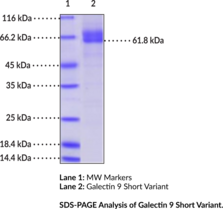
Galectin 9 is a ?-galactoside-binding protein encoded by the LGALS9 gene and a member of the galectin family.{56051} It contains two non-identical carbohydrate recognition domains (CRDs) joined by a peptide linker, the length of which depends on alternative splicing of the LGALS9 gene, which produces a short, medium, or long variant of the protein.{56051,56052} The non-identical CRDs are responsible for binding to different types of saccharide ligands with the N-terminal CRD (NCRD) preferring more complex glycoconjugates.{56051} Galectin 9 is localized to the cytosol, nucleus, and extracellular matrix and is expressed primarily in immune-related tissues and cells.{56053} When expressed on immune or tumor cells, galectin 9 binds to glycosylated sites on the immunoregulatory protein TIM-3 and activates signaling that impairs immune synapse formation leading to T cell anergy or apoptosis.{55230} It also binds to the transmembrane glycoprotein CD44 on osteoblasts, leading to their proliferation, and it has a role in cell adhesion by preventing hyaluronic acid from binding to CD44.{56054} The short variant of galectin 9 acts as an eosinophil chemoattractant.{56055} It also activates CD4+ T cell populations and induces naïve T cells to acquire a central memory T cell (TCM) phenotype.{56056} Galectin 9 was originally identified as a tumor antigen in patients with Hodgkin’s disease.{56051} It is expressed to a lower extent in tumor cells compared with non-tumor cells but is increased in leukemia and colon cancer cell lines.{56053} Increased expression of the short variant of galectin 9 inhibits or enhances adhesion in breast or colon cancer cell lines, respectively. The expression of the short variant of galectin 9 is increased by interferon ? (IFN-?) in synovial fibroblasts isolated from patients with rheumatoid arthritis.{56057} Cayman’s Galectin 9 Short Variant (human, recombinant) protein is a disulfide-linked homodimer. The reduced monomer, comprised of galectin 9 (amino acids 2-323) fused to human IgG1 Fc at its N-terminus, consists of 554 amino acids and has a calculated molecular weight of 61.8 kDa.
Cayman Chemical’s mission is to help make research possible by supplying scientists worldwide with the basic research tools necessary for advancing human and animal health. Our utmost commitment to healthcare researchers is to offer the highest quality products with an affordable pricing policy.
Our scientists are experts in the synthesis, purification, and characterization of biochemicals ranging from small drug-like heterocycles to complex biolipids, fatty acids, and many others. We are also highly skilled in all aspects of assay and antibody development, protein expression, crystallization, and structure determination.
Over the past thirty years, Cayman developed a deep knowledge base in lipid biochemistry, including research involving the arachidonic acid cascade, inositol phosphates, and cannabinoids. This knowledge enabled the production of reagents of exceptional quality for cancer, oxidative injury, epigenetics, neuroscience, inflammation, metabolism, and many additional lines of research.
Our organic and analytical chemists specialize in the rapid development of manufacturing processes and analytical methods to carry out clinical and commercial GMP-API production. Pre-clinical drug discovery efforts are currently underway in the areas of bone restoration and repair, muscular dystrophy, oncology, and inflammation. A separate group of Ph.D.-level scientists are dedicated to offering Hit-to-Lead Discovery and Profiling Services for epigenetic targets. Our knowledgeable chemists can be contracted to perform complete sample analysis for analytes measured by the majority of our assays. We also offer a wide range of analytical services using LC-MS/MS, HPLC, GC, and many other techniques.
Accreditations
ISO/IEC 17025:2005
ISO Guide 34:2009
Cayman is a leader in the field of emerging drugs of abuse, providing high-purity Schedule I-V Controlled Substances to federally-licensed laboratories and qualified academic research institutions for forensic analyses. We are certified by ACLASS Accreditation Services with dual accreditation to ISO/IEC 17025:2005 and ISO Guide 34:2009.